
Do we really need ANOTHER AI styling app?
If I'm not the target market...who is?

Ahh the good old days. Back when the idea of a computer dressing you was a futuristic fantasy.
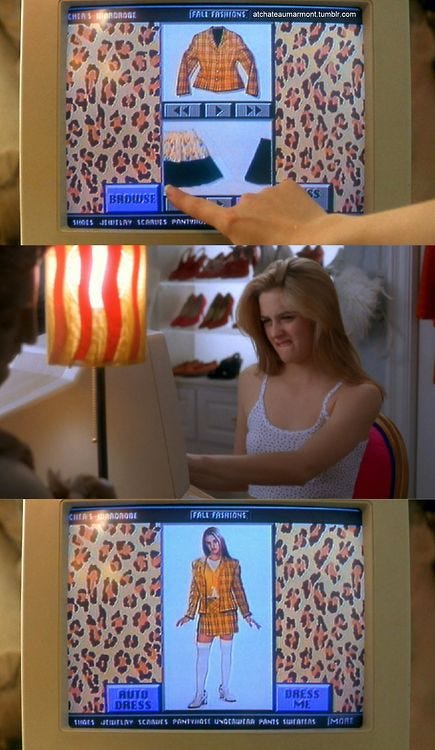
In Clueless, Cher Horowitz clicked through her wardrobe on a chunky desktop, matching her tops and bottoms to the perfect yellow plaid. It was camp, aspirational, ridiculous and magical in the best way. Almost three decades later, Silicon Valley is still chasing that feeling, only now it comes packaged as an AI styling app, promising to solve the eternal dilemma of what to wear today…
AI styling apps are multiplying like Zara blazers in an interns closet. Two distinct groups are emerging:
Startups trying to own the digital closet, raise venture rounds, and scale through affiliate links
Established brands layering AI into existing ecosystems, using it as retention more than revolution
Ralph Lauren just launched Ask Ralph, an AI co-stylist built with Microsoft/OpenAI.
Tote is pitching itself as a social wardrobe, learning from habits, purchases, and TikTok-fuelled communities.
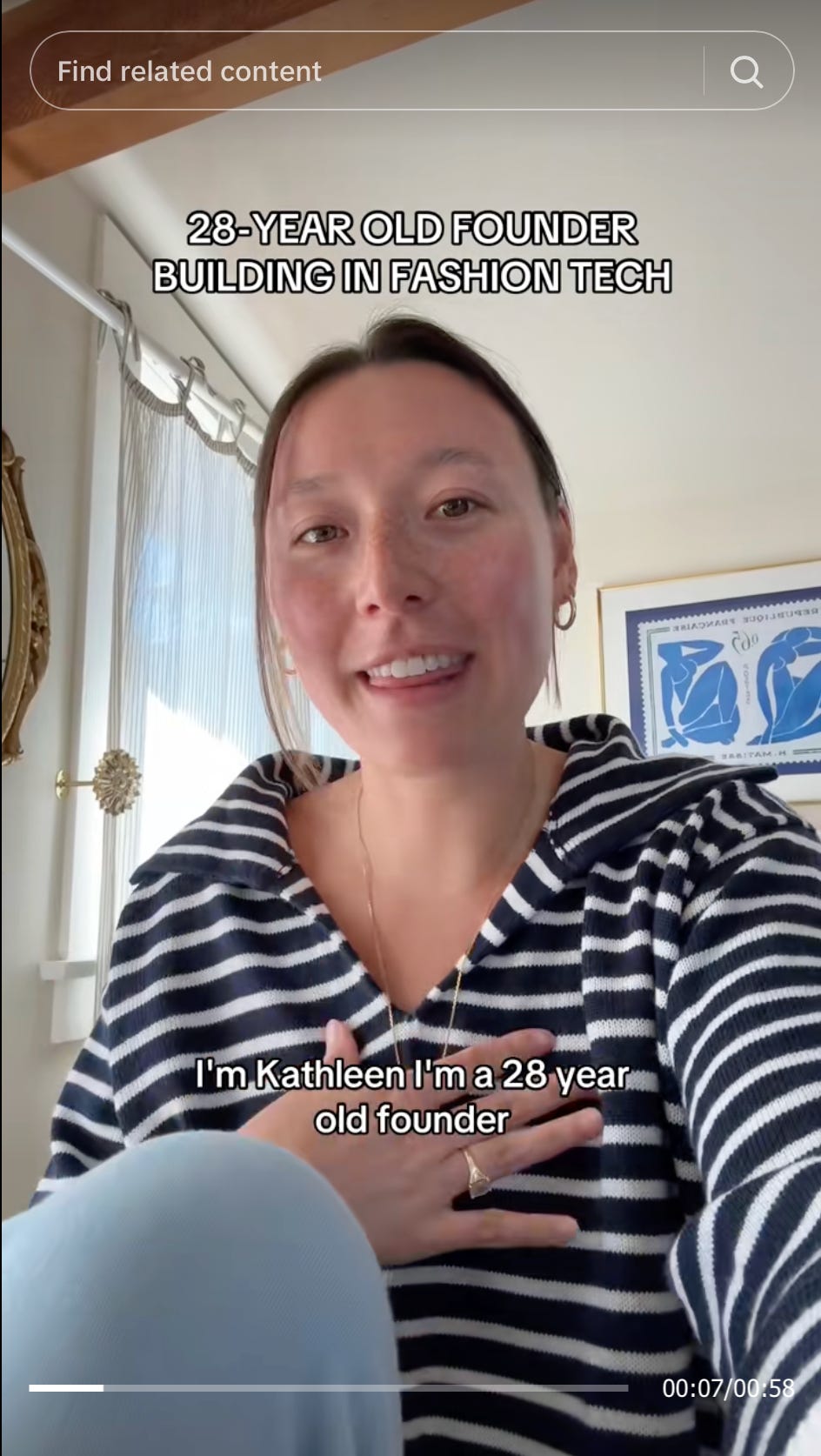
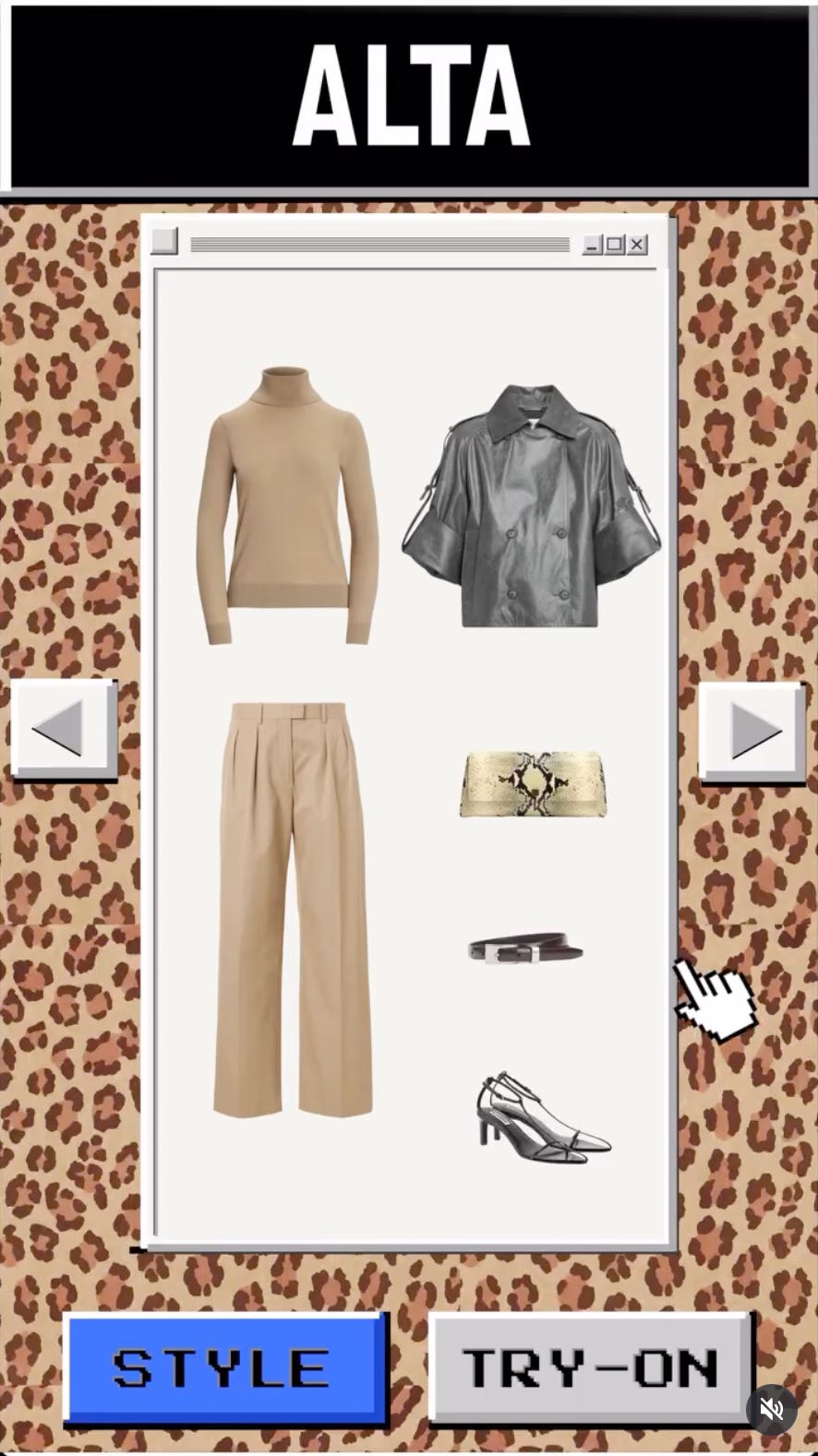
Alta raised an $11 million seed round from Menlo Ventures, Karlie Kloss, and Tony Xu; the app offers generative wardrobe curation with avatars and is already piloting programs with SourcedBy, CFDA and LVMH.
lookingGLASS, backed by Accenture Ventures, positions itself as an AI “remix” tool designed to get more from the clothes already in your closet, with an emphasis on sustainability.
Daydream, launched with nearly $50 million in seed funding, is led by ex–Stitch Fix COO Julie Bornstein and functions as an agentic AI shopping assistant spanning more than 8,000 brands.
Stitch Fix, the original player in algorithmic styling, continues to serve as a reference point with its hybrid human-plus-AI model.
Vivrelle’s Ella AI, launched in September 2025 with $19 million in funding, blends rental, resale, and retail in an attempt to redefine luxury “ownership.”
It’s a feeding frenzy, and I’ve definitely missed a few. The question is whether AI styling becomes a category in its own right, or just another feature swallowed by the platforms and retailers already dictating how we shop.
Why are there so many?
For founders and investors, the pitch is simple: people struggle to decide what to wear, they waste money on clothes they never use, and they return items at staggering rates (a billion-dollar headache for retailers). AI promises to fix all three by giving you hyper personal recommendations, predicting taste and reducing returns.
Purchasable products represent 2.1% of conversations. People literally ask “what should I buy?” Whoever nails the AI shopping layer will be the new SEO/affiliate giant.
Startups are clambering over each other to win this category. After years of “efficiency tech” for productivity and work, fashion looks like the next consumer vertical ready for reinvention. To VCs, AI styling isn’t just a fun idea - it’s the chance to own a daily ritual: getting dressed.
There’s also a meta-reason: AI styling is a sexy narrative. It’s futuristic enough to sell to press and investors (the Clueless reference writes itself), and it sits at the intersection of three massive markets: online apparel ($160B in the U.S.), affiliate marketing ($20B), and resale/rental (tens of billions globally).
How are they all VC backed?
The thing I am struggling to understand is how these startups are convincing credible VCs that they have a moat.
The whole premise of an AI styling app seems wrong to me - and I am the target demographic. I love shopping. I love getting dressed. And yet the idea of waking up, opening an app, and being told what to wear? This habit feels really unnatural and makes me cringe.
Do people really want an app mediating between them and their own closet every day, or is this just another case of investors falling in love with a spreadsheet, while the consumer shrugs.
Almost every name in this space is either raising or already funded. I assume these VCs have done their DD, and that the AI styling startups they are investing in have some sort of traction.
So if not me - who?
There will always be the early adopters - people in LA/SF who are close to startups and are constantly trying out new apps to see which one sticks.
There might be the practical crowd of users, who want the sartorial equivalent of a meal plan: simple, functional, reliable.
It could be the insecure ones, who need the app to whisper yes, this works, you will look hot AF today.
But who do you really need to be targeting?
In the US, there is a mass cohort of college age girls (18-22 year olds). When building anything to do with social commerce - they must be your North Star.
College girls represent one of the most powerful distribution engines in consumer culture. Campuses concentrate thousands of young women in dense social networks - sororities, dorms, classes - where trends can spread overnight. They’re hyperactive on TikTok and Instagram, which means their outfit choices and beauty routines double as marketing content with outsized reach. Their spending is real: surveys show that 18–22 year olds allocate more of their wallet to beauty and fashion than any other category, and their parents often subsidise that discretionary spend.
More importantly, this age is when habits form. Where to shop, what to wear, which apps to trust. Those loyalties can last a decade. Brands know that winning on campus means embedding into rituals like Rush, game days, or spring break, where purchases are social, visible, and repeatable. If AI styling is going to break through, it will start here.
So we need to think, why would a sorority girl use an AI styling app? Wouldn't they just yell down the hallway, or to their roommate, for their opinion? Because as much as fashion is personal, it is also very social.
I remember being a college, the endless hours we would spend in friends rooms trying on clothes, borrowing outfits, asking for opinions, sending pics to the group chat. Our friendship grew on that. Good luck replicating that with a bot.
This is where I think most AI styling pitches fall flat. They assume the problem is utility: choosing outfits faster, reducing waste, simplifying decisions, even making it ironically “more social” by connecting users online. But fashion isn’t just utility. It’s identity, performance, belonging. The apps that fail will be the ones that treat style as logistics, and no amount of venture capital can force a habit that makes its users cringe.
If you are bullish on the category, or any specific companies you think have a competitive advantage, I’d be interested to hear more - leave a comment below.
Without having used one in my life I’d actually really love it if it were vertically integrated with my actual wardrobe and washing machine irl. eg i open the wardrobe and it’s chosen todays outfit based on the weather and my calendar.
I like spending as little time as possible on this activity. Then when I’m done, it throw the clothes in the wardrobe bin and it automatically washes dries and folds the clothes.
Unfortunately I don’t know how big of a market male fashion is, given I don’t really consume much.
I have been in the fashion industry for 15+ years and I have yet to see anyone in the industry actually using of embracing these apps